⚡ Basic Electrical Simulations
Interactive simulators for Ohm’s law, AC/DC circuits, transformers, motors, rectifiers, and network analysis — master fundamental electrical engineering concepts with hands-on practice.
11 SIMULATORS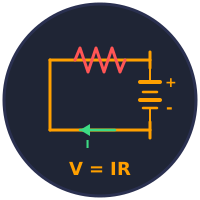
Understanding Basic Electrical Engineering Through Interactive Simulation
Electrical engineering forms the backbone of modern technology, yet many of its core concepts — voltage, current, impedance, electromagnetic induction — are invisible to the naked eye. Unlike mechanical systems where you can watch gears turn or beams deflect, electrical phenomena happen inside wires and components at the speed of light. This abstraction makes electrical theory one of the most challenging subjects for TVET and engineering students. Interactive simulators bridge this gap by providing real-time visual feedback: animated current flow, dynamic waveforms, rotating phasors, and colour-coded circuit diagrams that make the invisible visible.
Ohm’s Law, DC Circuits, and Kirchhoff’s Laws
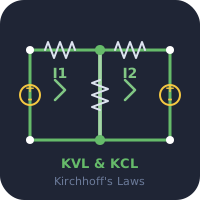
Every electrical curriculum begins with Ohm’s Law (V = IR), the relationship that links voltage, current, and resistance. From this single equation, students progress to series and parallel resistor networks, voltage dividers, and current dividers. Kirchhoff’s Voltage Law (KVL) states that the sum of voltage drops around any closed loop is zero, while Kirchhoff’s Current Law (KCL) states that currents entering a node must equal currents leaving it. Together, KVL and KCL enable the analysis of complex multi-loop circuits through mesh current and node voltage methods. Our Ohm’s Law simulator lets you build circuits and watch current flow in real time, while the Kirchhoff’s Circuit Solver handles multi-loop networks with matrix-based analysis and step-by-step solution display.
RC and RLC Circuits — Transients and AC Resonance
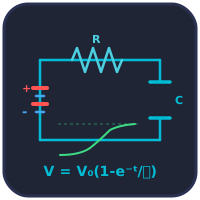
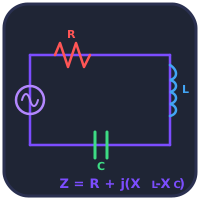
When capacitors and inductors enter the picture, circuits exhibit time-dependent behaviour. An RC circuit charges exponentially with time constant τ = RC, reaching 63.2% of its final voltage in one time constant and 99.3% in five. Adding an inductor creates an RLC circuit, which can oscillate, overdamp, or critically damp depending on the component values. Under AC excitation, RLC circuits exhibit resonance at f = 1/(2π√LC), where impedance is minimised (series) or maximised (parallel) and current reaches its peak. Phasor diagrams rotate to show the phase relationship between voltage and current. The RC Circuit simulator animates charging and discharging curves, and the RLC Circuit simulator provides frequency sweep, impedance plots, and interactive phasor visualisation.
Transformers, Rectifiers, and Power Conversion
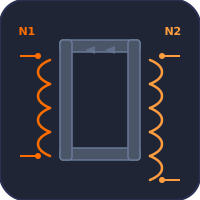
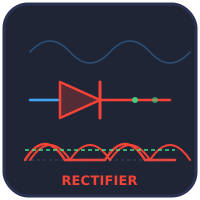
Transformers are essential for voltage transformation in AC power systems. The turns ratio N1/N2 determines the voltage and current transformation, while real transformers introduce copper losses (I²R), core losses (hysteresis and eddy currents), and leakage reactance. Diode rectifiers convert AC to DC through half-wave, full-wave centre-tap, and bridge configurations. The ripple voltage depends on the load current and filter capacitor size, with the bridge rectifier providing the best utilisation of the transformer secondary. Our Transformer simulator compares ideal and real transformer behaviour with animated flux, and the Diode & Rectifier simulator shows waveform transformation with smoothing capacitor effects.
DC Motors, AC Generators, Star-Delta Conversion, and Capacitor Banks
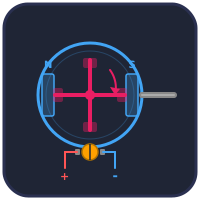
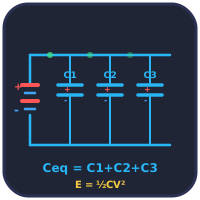
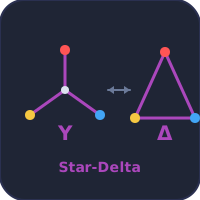
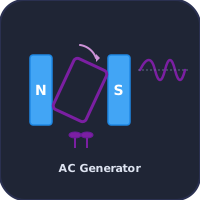
DC motors convert electrical energy to mechanical rotation through the interaction of armature current and magnetic field. The back EMF (E = kφN) opposes the supply voltage and self-regulates motor speed. Different winding configurations — shunt, series, and separately excited — produce distinct speed-torque characteristics suited to different applications. AC generators (alternators) work on the opposite principle: a rotating coil in a magnetic field produces a sinusoidal EMF whose frequency depends on rotational speed and number of poles (f = NP/120). Our AC Generator simulator visualises the rotating coil, instantaneous EMF, and output waveform with RMS voltage and frequency calculations. In three-phase systems, star (Y) and delta (Δ) connections provide different voltage and current relationships, and star-delta starting reduces inrush current to one-third of direct-on-line starting. Capacitor banks in series reduce equivalent capacitance while increasing voltage rating, whereas parallel banks increase total capacitance for energy storage and power factor correction. The DC Motor simulator, Star-Delta converter, and Capacitor Bank calculator let you explore these concepts with animated diagrams and instant calculations.
The Wheatstone Bridge — Precision Measurement
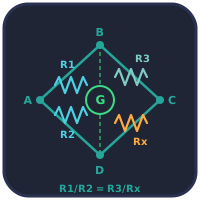
The Wheatstone bridge is a fundamental measurement circuit that determines an unknown resistance by balancing two voltage divider legs. When the bridge is balanced, no current flows through the galvanometer and the unknown resistance equals R2×R3/R1. Unbalanced bridges are used in strain gauge circuits, temperature sensors, and industrial instrumentation. The Wheatstone Bridge simulator animates galvanometer deflection and lets you adjust resistor values to achieve balance, reinforcing both the theory and practical technique of bridge measurement.
Who Uses These Simulators?
These electrical simulators serve TVET diploma students studying basic electrical engineering, polytechnic and university students in their circuits courses, apprentice electricians learning theory alongside workshop practice, and instructors who need interactive demonstrations for classroom teaching. Each simulator includes four learning modes — Simulate, Explore, Practice, and Quiz — making them ideal for self-study, guided instruction, and formal assessment.
Explore Related Simulators
If you found these electrical simulators useful, explore our Stress-Strain Diagram simulator for material properties under load, Heat Transfer Modes simulator for conduction, convection, and radiation, Simple Harmonic Motion simulator for oscillatory systems, and Beam Bending Calculator for structural analysis — all free with practice and quiz modes.