🧪 Virtual Lab Testing
Interactive material testing simulators for engineering education
5 tools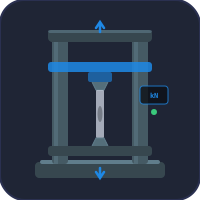
Virtual Lab Material Testing — Interactive Simulators for Engineering Education
Material testing is the cornerstone of mechanical engineering practice. Before any component enters service — whether a bridge girder, an aircraft fastener, or a simple machine shaft — engineers must verify that the material can withstand the loads it will face. Traditionally, students learn these tests in physical laboratories equipped with expensive machines and consumable specimens. MechSimulator's virtual lab testing suite brings five of the most important destructive tests directly into the browser, allowing unlimited practice at zero cost. Each simulator reproduces the test procedure, generates realistic data curves, and teaches the underlying theory through guided exploration, practice exercises, and timed quizzes.
Tensile and Compression Testing with the UTM
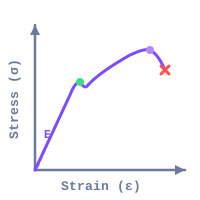
The Universal Testing Machine (UTM) is the workhorse of any material testing laboratory. It applies controlled axial loads to a specimen and records force versus elongation in real time, producing the stress-strain curve that defines a material's mechanical behavior. In our UTM Virtual Lab, students can load seven different engineering materials — from mild steel to aluminium alloy — and observe elastic deformation, yielding, strain hardening, necking, and fracture. The simulator calculates Young's modulus, yield strength, ultimate tensile strength, and percentage elongation automatically, reinforcing the connection between raw test data and the material properties listed in engineering handbooks. Students can also switch between tensile and compression modes to compare how ductile and brittle materials respond differently under opposing load directions.
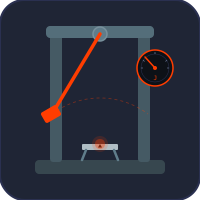
Impact Testing: Charpy and Izod Methods
Where the UTM applies loads slowly, impact tests apply them suddenly to measure a material's toughness — its ability to absorb energy before fracturing. The Impact Testing Virtual Lab simulates both the Charpy (simply-supported beam) and Izod (cantilever) configurations. Students release a pendulum hammer, observe the energy absorbed during fracture, and study how toughness changes with temperature by plotting ductile-to-brittle transition temperature (DBTT) curves. Understanding DBTT is critical in industries such as shipbuilding and pipeline engineering, where low-temperature service can cause catastrophic brittle fracture if the wrong steel grade is selected.
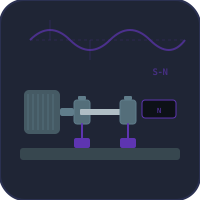
Fatigue Testing and S-N Curves
Most mechanical failures in service are not caused by a single overload but by millions of repeated stress cycles — a phenomenon called fatigue. The Fatigue Testing Virtual Lab models the classic R.R. Moore rotating beam test, where a polished specimen spins under a constant bending moment until it cracks. By running tests at different stress amplitudes, students construct the S-N (stress vs. number of cycles) curve and identify the endurance limit — the stress level below which the material can theoretically survive infinite cycles. The simulator also visualises crack initiation and propagation, helping students understand why surface finish, stress concentrations, and mean stress all influence fatigue life in real components.
Stress-Strain Diagrams and Hardness Testing
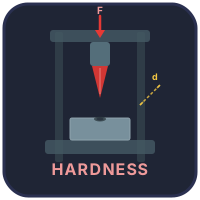
Complementing the full machine simulators, the Stress-Strain Diagram trainer lets students drag an interactive point along the curve to explore each region — proportional limit, elastic limit, yield point, strain hardening, UTS, and fracture — while the simulator displays Hooke's Law calculations, Poisson's ratio, and factor of safety in real time. Meanwhile, the Hardness Testing Simulator covers three industry-standard methods: Brinell (steel ball indenter under high load), Rockwell (cone or ball with preliminary and major loads), and Vickers (diamond pyramid with precise indentation measurement). Each method animates the indentation process and walks students through the hardness number calculation step by step.
Why Virtual Labs Matter for TVET Students
Technical and vocational education (TVET) programs often serve large class sizes with limited laboratory hours and equipment budgets. A single UTM machine can cost tens of thousands of dollars, and every tensile specimen is destroyed after one test. Virtual labs solve both constraints: students can repeat each experiment as many times as needed, make mistakes without consequences, and build genuine understanding of test procedures before touching real equipment. The result is safer, more confident learners who arrive at the physical lab already knowing what to expect. For distance-learning and hybrid programs, virtual labs ensure that every student — regardless of location — receives the same quality of hands-on practice.
Explore Other Categories
Expand your engineering skills with simulators from other categories on MechSimulator. Practice with our Strength of Materials simulators for beam bending, truss analysis, and bolted joint design. Sharpen your precision measurement skills with the Measuring Instruments collection, featuring Vernier calipers, micrometers, and dial gauges. Or explore heat transfer, thermodynamic cycles, and fluid flow in the Thermal & Fluid Systems category.